
We won't be here forever.

We won't be here forever.

We won't be here forever.

With compassion and respect, the dedicated staff at Finger Lakes Donor Recovery Network honor every donor hero, support their grieving families with unwavering care, and passionately fulfill the Donate Life mission that turns tragedy into hope and saves countless lives.

The Hospital’s Role in the Donation Process

The Hospital’s Role in the Donation Process

Organ, eye, and tissue donation wouldn’t be possible without the support and collaboration of our hospital partners. By working together, we’re best able to honor end-of-life decisions of patients or their legal next of kin – resulting in saving and improving the lives of others who are waiting for organ and tissue transplants.

State law and federal Medicare/Medicaid rules require hospitals to refer all imminent and actual deaths as well as preserve the option for organ, eye, and tissue donation.

Making the Referral Call:

Imminent Deaths:
Hospitals must refer any patient meeting clinical triggers for organ donation within 2 HOURS.

Cardiac Deaths:
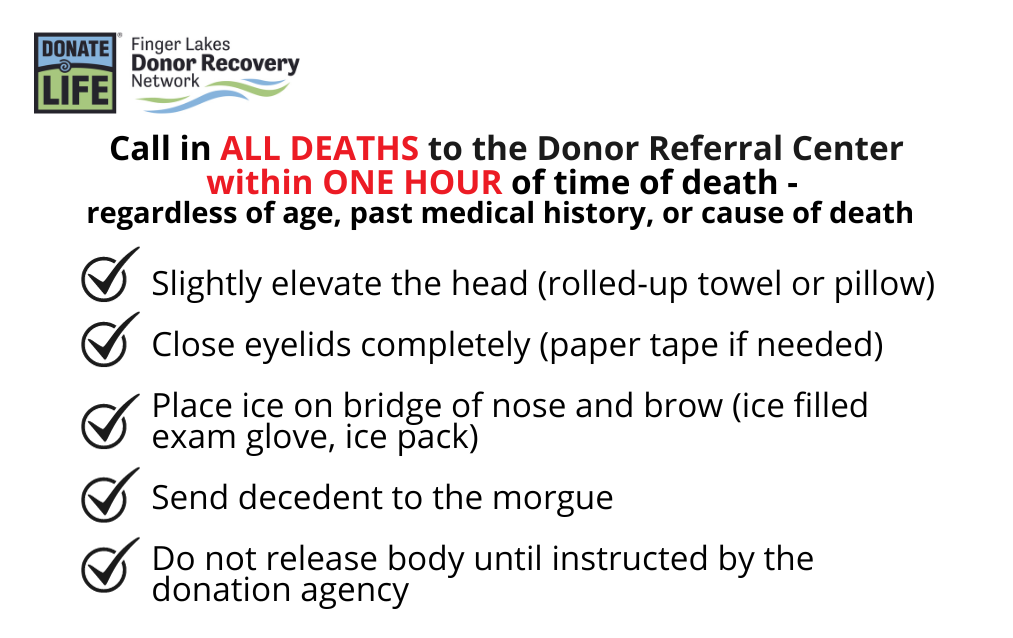
Hospitals must refer all deaths within 1 HOUR of cardiac time of death, even if the patient had previously been referred for organ donation.

Preserving the Option for Donation:

Hospitals must preserve the patient’s opportunity to donate organs, tissues, and eyes until the donation agency has completed its evaluation and discussed donation opportunities with legal next of kin.

For patients referred for organ donation (imminent death), the hospital care team is to continue medical support of the patient while donation options are being assessed. Most importantly, the patient must remain on the ventilator and not be palliatively extubated until the donation process is complete, or Finger Lakes Donor Recovery Network has notified the care team that the patient doesn’t have donation options.

After making a referral for tissue and eye donation, the following should be done to preserve the option to donate:
Finger Lakes Donor Recovery Network’s Role in the Donation Process

As a federally designated Organ Procurement Organization (OPO), Finger Lakes Donor Recovery Network is responsible for the coordination of organ recovery for transplantation from deceased donors. Based on Regulatory Requirements for OPOs, Finger Lakes Donor Recovery Network will determine medical suitability for donation and initiate donation conversations with legal next of kin.

Coordinating Organ Donation

Our responsibilities in the organ donation process include:

  • Assessment of the patient’s potential to donate organs or tissues.
  • Works with hospital staff to determine the legal next-of-kin’s understanding of the patient’s prognosis and assess their readiness for the donation conversation.
  • Presents the next of kin with the opportunity for organ and tissue donation at an appropriate time.
  • Obtains authorization, donor health history, and all other required documents for donation.
  • Allocates organs for transplant according to national organ-sharing policies overseen by the United Network for Organ Sharing, or for research.
  • Works with hospital staff to medically manage the patient to ensure optimal organ function and maximize gifts made by the donor.
  • Coordinates the surgical recovery of organs at the donor hospital with incoming transplant teams.
  • Manages preservation of organs for transportation to transplant centers and patients awaiting life-saving transplants.
  • Provides donor families/legal next-of-kin information about donation outcomes and aftercare services.
  • Provides post-donation follow-up and case review to hospital medical staff.
Translate »